Plants don't care where the water came from — they care what's dissolved in it. Here's a no-nonsense guide to picking the right water source for your hydroponic setup.
Tap water — usually fine
If your tap water tests below 300 ppm total dissolved solids and isn't heavily chlorinated, you can use it straight. Let it sit uncovered for 24 hours to off-gas chlorine, or use a cheap inline carbon filter.
When tap water becomes a problem
- Hard water (above 200 ppm calcium/magnesium) throws off your nutrient math.
- Chloramine (instead of chlorine) doesn't off-gas — you need a carbon block.
- Well water often has iron, sulfur, or unpredictable pH swings.
Filtered water
A standard activated-carbon pitcher handles chlorine and most taste/odor issues. It does not remove minerals, so your starting ppm stays the same.
Reverse osmosis (RO)
RO strips almost everything, giving you a clean slate around 0–20 ppm. Worth it if you have very hard water or you're running picky plants like strawberries. Just remember to add a Cal-Mag supplement — pure RO can leave plants deficient.
The simple rule
Test your tap once with a $15 TDS meter. Under 200 ppm? Use it. 200–400 ppm? Filter and adjust. Above 400 ppm? Invest in RO or buy distilled.
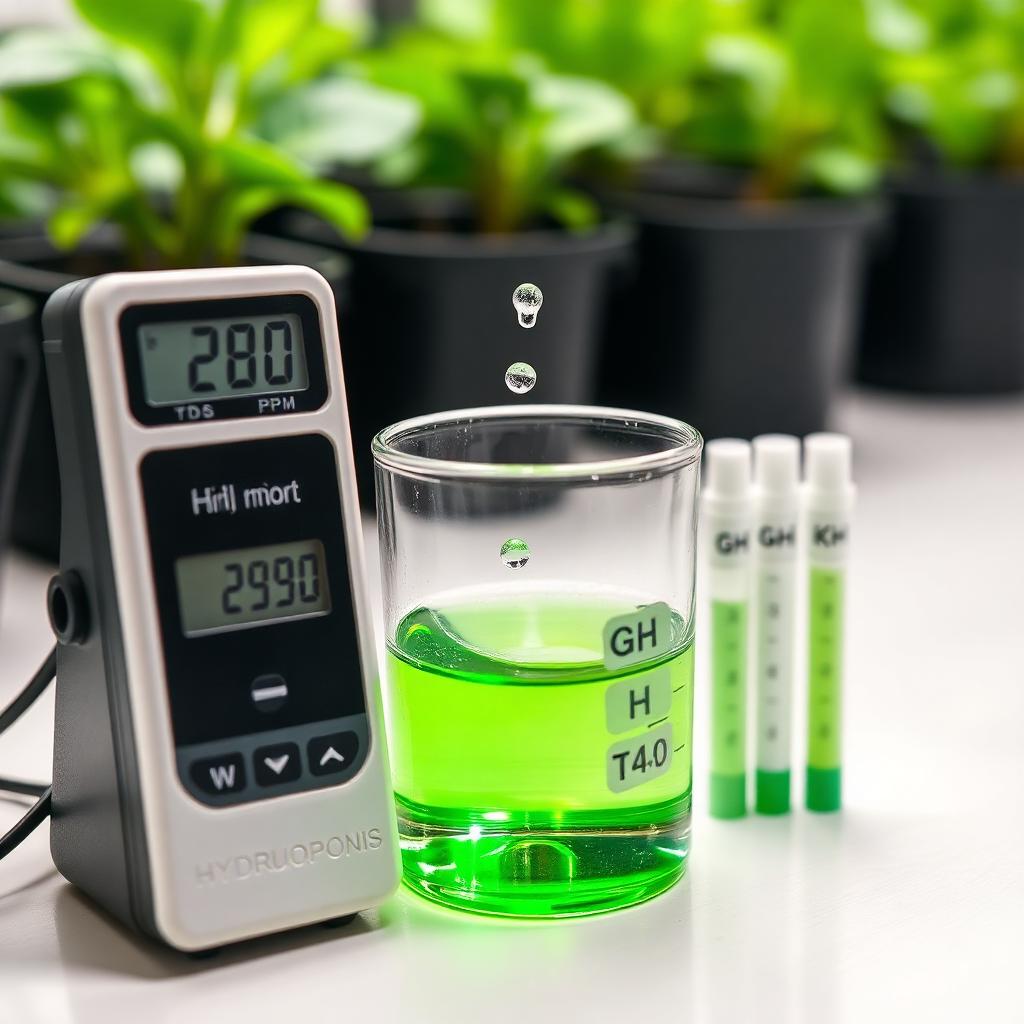
What a real tap-water test costs and tells you
A £12 TDS meter and a £6 GH/KH test kit will tell you more about your hydroponic destiny than most £150 setups. For around £20 once you can know exactly where you sit on the hardness scale, whether chloramine is in your supply, and what your starting EC will be before you add any nutrient.
A 30-second decision tree
- Under 150 ppm: Use straight from the tap. Add Cal-Mag for fruiting plants.
- 150–300 ppm: Use it, but reduce your nutrient dose by 10–15% to compensate for what is already dissolved.
- 300–450 ppm: Mix 50/50 with distilled or RO for sensitive crops; pure tap is fine for lettuce and herbs.
- Above 450 ppm: Use RO or distilled and add a full Cal-Mag supplement.
The chloramine trap
Many UK water authorities switched from chlorine to chloramine in the last decade. Chloramine will not off-gas by leaving water in an open bucket overnight — a stubborn myth. If your supplier uses it (a quick web search of your postcode usually confirms), you need either a carbon block filter, a vitamin C dechlorinator, or to switch to RO. In our long-running DWC tank we saw a clear root-rot increase the first time we accidentally used straight chloraminated water for three top-ups in a row.
Frequently asked questions
Is distilled water safe for hydroponics?
Yes — it behaves just like RO water. Add Cal-Mag and your normal nutrients.
Will softened water work?
No — water softeners replace calcium with sodium, which is toxic to plants in any quantity.
Comments (0)
Join the conversation. Be kind — offensive language is automatically filtered.
Loading…
Loading comments...
Keep reading
Beginner
Hydroponic Nutrients Explained: NPK, pH and EC for Beginners
NPK, pH, EC — what the numbers actually mean, and a feeding routine you can stick to.
Beginner
10 Common Hydroponic Mistakes (and How to Fix Them)
Yellow leaves, slimy roots, algae — the real causes and the 30-second fixes.
Beginner
Hydroponics for Beginners: A Complete Starter Guide
What hydroponics is, the 6 main types, and exactly which one to pick if you've never grown a plant.