Once you outgrow the mason jar, the two most popular DIY systems are Deep Water Culture (DWC) and Nutrient Film Technique (NFT). They sound similar; they're really not.
Deep Water Culture (DWC)
Plants float on a Styrofoam or plastic raft with roots dangling in a tub of aerated nutrient water. An air pump bubbles oxygen into the reservoir 24/7.
Nutrient Film Technique (NFT)
A thin "film" of nutrient water flows down a slightly sloped channel — usually a length of PVC. Roots sit in the channel and drink as the film passes.
Side-by-side
- Build cost: DWC ~$60. NFT ~$120.
- Power draw: DWC needs an air pump (~5W). NFT needs a water pump (~10W).
- Failure mode: DWC pump fails → roots get oxygen-starved in hours. NFT pump fails → roots dry out in hours. Both are risky if you're away.
- Best plants: DWC: lettuce, basil, herbs. NFT: lettuce, strawberries, almost anything light.
Which should you start with?
DWC, every time. It's simpler to build, cheaper to debug, and you can build a functional 4-plant unit out of a $5 storage tote in an afternoon.
When to graduate to NFT
Once you want 12+ plants in a tidy footprint, NFT scales beautifully — that's why nearly every commercial lettuce farm uses it.
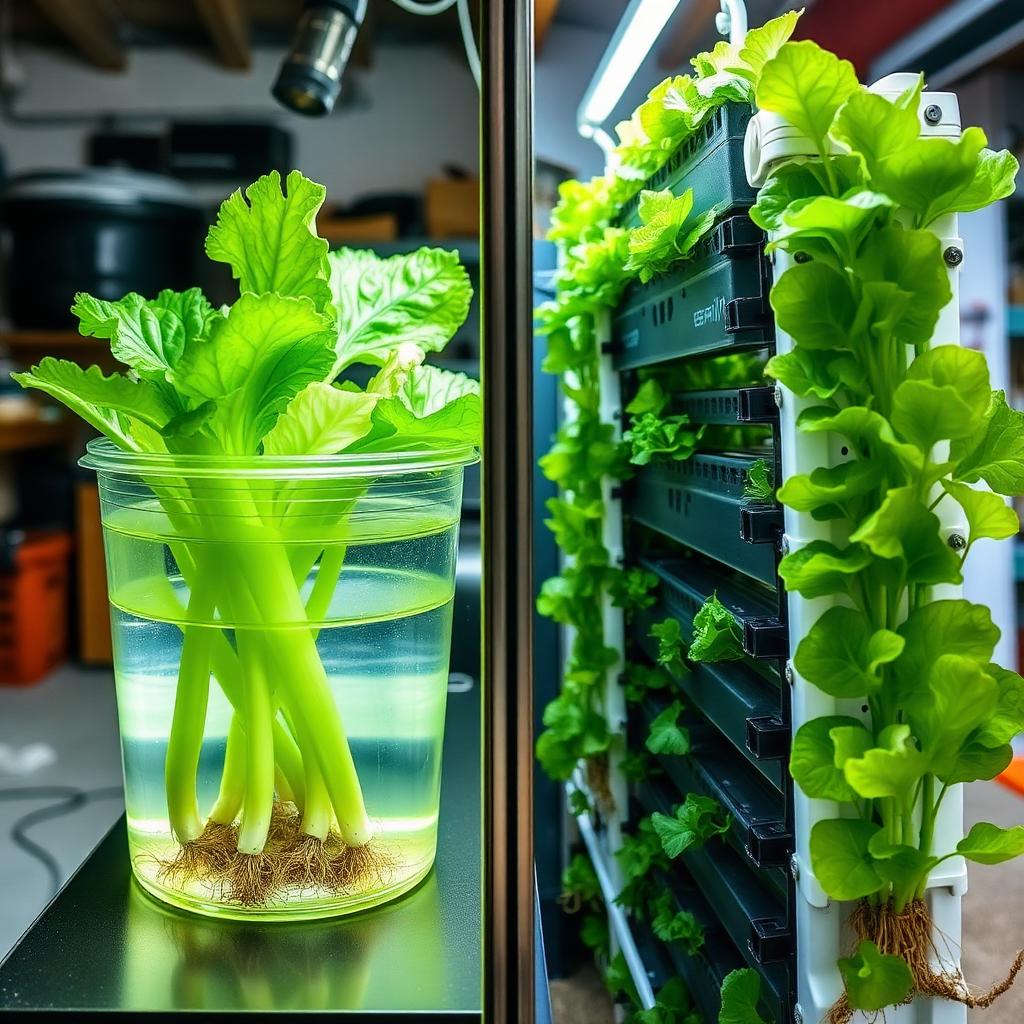
Two systems we have run side by side for over a year
We keep a four-bucket DWC and a six-channel NFT rack running in parallel because the two systems answer different questions. DWC is what we recommend for someone growing two or three big plants — a couple of tomatoes, a pepper, a clump of basil — and wanting the simplest possible mechanical setup. NFT is what we recommend for someone who wants a salad-a-day production line of lettuce in the smallest possible footprint.
The failure modes are completely different
- DWC fails slowly. Root rot from too-warm water, low dissolved oxygen, or a pump that dies overnight. You usually have 24–48 hours to catch it.
- NFT fails fast. A blocked channel, a tipped tray, or a pump failure can dry roots within four hours and lose the entire rack.
We added a £8 mechanical timer that runs the NFT pump for two minutes every fifteen minutes instead of continuously — same yield, dramatically more forgiving when something clogs.
Yield, electricity and what actually matters at home
Across two full 8-week cycles of buttercrunch, our NFT rack produced about 18% more usable weight per square foot of floor than DWC. The DWC system, however, used 60% less electricity (one air pump versus a water pump on a 24/7 duty cycle). For most apartment growers the electricity gap matters more than the yield gap — DWC is the answer roughly two-thirds of the time.
Frequently asked questions
Can I run NFT off solar?
Yes, but you need a battery backup — even a 15-minute pump outage can kill the plants.
Do I need to clean DWC tubs?
Yes — scrub between cycles to prevent biofilm and algae.
Comments (0)
Join the conversation. Be kind — offensive language is automatically filtered.
Loading…
Loading comments...
Keep reading
Beginner
The Kratky Method, Explained Simply
Grow lettuce in a mason jar with no pumps, no electricity, almost no effort.
Beginner
Hydroponics for Beginners: A Complete Starter Guide
What hydroponics is, the 6 main types, and exactly which one to pick if you've never grown a plant.
Beginner
Hydroponic Nutrients Explained: NPK, pH and EC for Beginners
NPK, pH, EC — what the numbers actually mean, and a feeding routine you can stick to.