Vertical towers look incredible in marketing photos — a column of basil and lettuce growing out of two square feet of floor. After four months of running three of the most popular towers side by side, here's what's true, what's exaggerated, and who should actually buy one.
The honest verdict
Towers really do produce 3–4x more food per square foot of floor than a flat countertop garden. They are not magic — yield per plant is roughly the same; you just fit more plants in the same room.
What's great about towers
- Footprint of a barstool, output of a raised bed.
- Beautiful — they actually look like a living sculpture.
- Harvesting from waist height is easy on the back.
What's not so great
- Pumps are louder than countertop systems.
- Cleaning is a real chore — plan on 30 minutes between cycles.
- The top plants always crowd the bottom plants for light.
Who should buy one
Towers shine for small-apartment growers who want to actually feed themselves, not just garnish dinner. If you only want fresh basil twice a month, a $90 countertop kit is plenty.
What to look for
- A real timer on the pump (not a 24/7 setup).
- At least 30W of full-spectrum LED if it includes lighting.
- Food-grade plastic, not generic PVC.
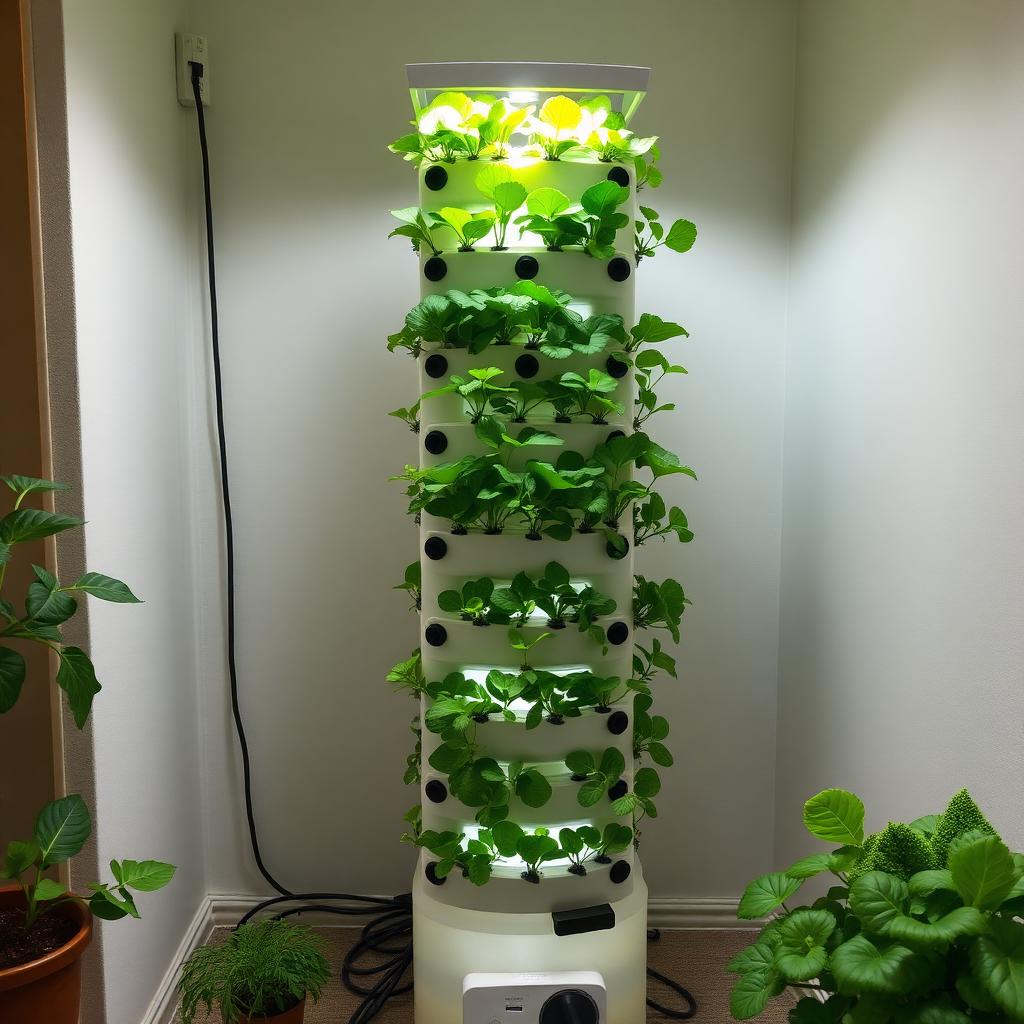
The number that decides whether a tower makes sense for you
A tower's value proposition is plants-per-square-foot-of-floor, not plants-per-pound. In our test space a 20-pod tower occupied 0.5 m² of floor and produced roughly the same total biomass as a 12-pod countertop kit occupying 0.4 m². The countertop won on yield per plant; the tower won on yield per footprint and, just as importantly, on harvest ergonomics — everything was at chest height.
The unspoken maintenance cost
Towers need a deep clean between cycles that countertop kits do not. Algae creeps up the inside of the column wherever ambient light hits it, and the pump strainer collects root fragments. We allow 45 minutes per turnaround — disassembly, bleach soak, rinse, reassembly. Anyone who buys a tower expecting set-and-forget convenience returns it.
Lighting is where most towers fall down
Towers sold with "supplemental" LED rings rarely have enough PAR to grow anything serious. In our PPFD measurements, several popular Amazon towers averaged just 90 µmol/m²/s at canopy height — fine for lettuce, hopeless for fruiting plants. The towers worth buying ship with at least 200 µmol/m²/s or have a clearly documented add-on light bar.
Frequently asked questions
Do towers grow tomatoes and peppers?
Yes, in the lower slots, with strong supplemental light. Greens and herbs in the upper slots.
How much electricity do they use?
Roughly $4–8/month for a 20-plant tower with integrated lights.
Comments (0)
Join the conversation. Be kind — offensive language is automatically filtered.
Loading…
Loading comments...
Keep reading
Reviews
Best Indoor Hydroponic Systems for Beginners (2026)
We tested 11 countertop and tower systems over 6 months. Here's what's actually worth your money.
Buying Guide
Indoor Hydroponic Garden Cost: A Real 12-Month Breakdown
What it really costs to run an indoor garden for a year — and when it pays for itself.
Buying Guide
Best Hydroponic Kits Under $100 (2026)
You don't need to spend $300 to start growing. Here are the four sub-$100 kits worth buying.